Hi, I’m trying to familiarize myself with MolFlow (and molecular flow in general), so I’ve been digging into some analytical solutions for simple geometries, such as flow out of a cylindrical pipe. To make the comparison (namely to the solution put forth by Clausing, Ann. Phys. 12, 961 (1932)), I’ve placed “witness” facets with opacity 0 above the top end of a cylindrical pipe that has a desorption source at the bottom end. The witness facets are typically within a cylinder above the source pipe, and I’m unclear how/why setting toggling between sticking factors=1 and opacity=0 of those cylinder’s enclosing facets changes the recorded MC hits on those witness facets (with one extreme being the opacities set to 0 and recording no MC hits). From a physical perspective, (I think) the difference between sticking factors = 1 and opacities =0 would be a finite volume that is pumped vs an unpumped infinite volume. But, I’m unsure where those physical differences manifest in MolFlow
To help imagine your setup better, could you post a screenshot where we can see the flow, and the witness facet position?
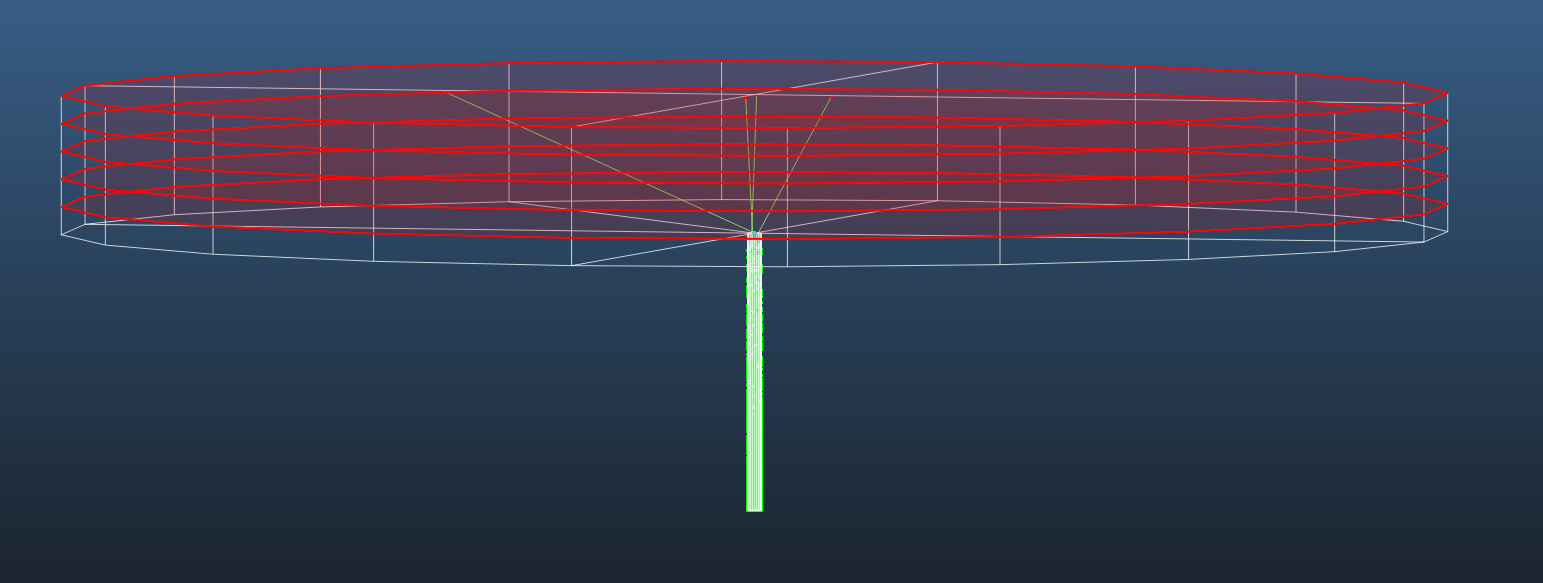
If the large outer volume on top has sticking=1 on all sides, i.e. there are no reflected molecules, then sticking=opacity=1 on a witness facet should give the same impingement rate (MC hits normalized by number of test particles created) as if you set that facet’s opacity to 0.
The witness facets must have their normals towards the source.
Please note though that if you place a witness facet exactly at the position of an other facet that’s not transparent, the result will be undetermined (Molflow won’t be able to decide which of the two is hit first). I’m not sure if you have such case.
If you don’t get the above expectation, upload the geometry, with a concrete result you expect and what you get instead, and I can take a look.
Thanks for the reply, sorry for the confusion but the witness facets that I’ve highlighted are always opacity=0, sticking factor=0 (though, to double check my understanding, the sticking factor is value is extraneous and unused for a facet with opacity=0?).
The question was in regards to changing the properties of the facets comprising the surface area of the large outer volume, namely the rectangles comprising the curved surface as well as the top circular cap, and the subsequent impact on the witness facets. What should be the difference in MC hits on the witness facets if the facets comprising the large outer volume surface area have opacity=sticking=1 vs. opacity=sticking=0 vs. sticking=1, opacity=0. Physically these describe very different scenarios but how MC hits/transparent passes on the witness facets, before a test particle encounters/”knows” the prescribed conditions at the enclosing facets, change with these different scenarios
-
Yes, a transparent facet (opacity=0) doesn’t interact with the particles, so sticking value is not taken into account.
-
If the side facets of the large volume are opacity=0, then there are leaks, which can be visualized in the upper right corner view options. Leaks, which are a simulation error, aren’t registered as hits (this is due to how the ray tracing engine works - if there is no next collision, the particle is eliminated, regardless of intermediate witness facets). This excludes the opacity=0 cases from the three that you cite, leaving only opacity=sticking=1 as valid.
I appreciate the informative response, that clears it up for me. Thanks!